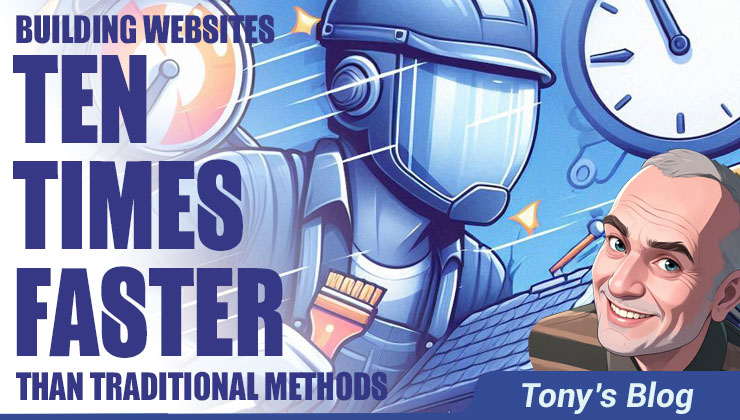
Claude Code for Web Development: How I Build Websites 10x Faster Than Traditional Methods
The Secret Isn’t the Tool. It’s What Comes Before.
Here’s something that will sound completely backwards: the secret to building websites 10 times faster isn’t Claude Code. It’s everything I’ve built around it.
I’m a web developer based in Telford, Shropshire, and I’ve been building with Claude Code since it launched. A developer downloading it for the first time and me using it are not the same thing. The tool is identical. The results aren’t even close. That gap has nothing to do with talent and everything to do with context.
I’ve spent months building a system where every session starts with Claude Code knowing the businesses I serve, my code patterns, my service methodology, my voice, my project history. It doesn’t guess. It doesn’t need explaining. It loads the context documents, reads the codebase, and starts working with the full picture from the first command.
A developer without that context is starting from zero. Every single time.
The Session Principle
I have a rule that changed how I think about work. I call it the Session Principle, and it goes like this:
By the time the cafe unlocks the door, I’ve already served thirty covers.
Traditional development estimates exist in a world of sprints and standups and two-week cycles. That world has nothing to do with mine. When I sit down for a session, the mise en place is already done. The context documents are loaded. The wiki has the methodology. The codebase has the patterns. The system knows the business.
The unit of work is sessions, not weeks. And a single session with full context produces more than most teams produce in a sprint.Here’s a real example from last week. In one session I fixed an API integration, removed broken pages, added FAQ schema to five pages, built internal cross-linking across a site, added a deadline banner, mapped seven content pillars, built a citation system with property type detection, restored three broken commands, added six business directories, wrote two documentation pages, and applied for four affiliate programmes.
The speed isn’t coming from typing faster or having a better framework. It’s coming from the fact that every session I’ve ever had has been building the context for this one. The system doesn’t need a requirements meeting because the requirements are documented. It doesn’t need an architecture review because the architecture is in the codebase. It doesn’t need onboarding because the onboarding happened months ago and has been compounding ever since.
Why Context Beats Tools Every Time
Traditional AI coding works like this: you ask for help, it generates something generic, you spend an hour wrestling it into shape because it doesn’t understand your project, your standards, or your clients.
Claude Code is different. But even Claude Code, without context, is just a faster way to write code that might not fit your project.
What makes it genuinely transformative is when it has the full picture:
Pattern recognition. My codebase has patterns established across dozens of client sites. When Claude Code builds a new page, it doesn’t invent an approach. It follows the patterns that already work. Consistent components, consistent styling, consistent structure. That consistency is worth weeks of development time on its own.
Institutional knowledge. My context documents hold what I’ve learned about every client. Their industry, their competitors, what’s worked, what hasn’t. Claude Code doesn’t ask “what does this client do?” - it already knows. It can write their copy, audit their content, recommend their next move, because the knowledge is loaded before the session starts.
Error elimination. Most bugs come from misunderstanding. When Claude Code understands the full system - not just the file it’s editing, but how that file connects to everything else - errors drop dramatically. It knows the database schema, the API endpoints, the deployment process, the naming conventions. Misunderstandings require gaps, and context fills the gaps.
The Boring Stack That Makes This Possible
Context is the strategy. But you need the right tools underneath it. I chose every piece of my technology stack because it’s deliberately “boring” - and boring is exactly what makes context-driven development work.
Astro: Plain HTML That AI Understands Perfectly
Astro generates plain HTML. No framework JavaScript shipped to the browser. No React hydration. No complex state management.
Why this matters for context: Claude Code has seen millions of examples of HTML. The patterns are well-documented, consistent, predictable. When I ask it to build a page, it doesn’t have to navigate framework quirks or fight breaking changes from the latest release. It just writes clean HTML that works everywhere.
The Energy Grants site loads in 0.3 seconds. That’s not a framework achievement. That’s what happens when you remove everything unnecessary and let proven technology do its job.
Tailwind CSS: Design at the Speed of Context
Tailwind is just CSS classes. No runtime. No styled-components. No naming convention debates.
When Claude Code has my existing components as context, it can prototype layouts at the speed of thought. Professional forms, responsive grids, mobile-perfect layouts - all built in hours because the patterns are already established and Claude Code can replicate them instantly.
Django: Twenty Years of Stability
Django has been around since 2005. It’s mature. It’s predictable. Every problem I’ll encounter has been solved, documented, and trained into Claude Code.
That maturity is the point. When Claude Code writes Django code, it’s drawing on twenty years of best practices. No breaking changes, no conflicting community advice, no dependency conflicts. Just a stable foundation that AI understands thoroughly.
Claude Code: The Tool That Reads the Room
Claude Code reads my entire codebase. It executes commands. It tests its own work. It fixes errors immediately. But none of that matters without context. A brilliant musician with no knowledge of the set list is just making noise. Claude Code with my full context - the wiki, the client documents, the code patterns, the service methodology - knows the set list. It plays the right notes because I’ve spent months teaching it the songs.
The Real Case Study: Energy Grants
Let me show you how context-driven development works in practice.
I didn’t start by telling Claude Code what to build. I asked it a question: “How can we build a website that helps people find the energy grants available by utilising government APIs?”
That question, asked in the context of my full system - my Astro patterns, my deployment process, my SEO methodology - produced an architectural recommendation I wouldn’t have reached on my own. Start with a static prototype. Add API integration later. Use Astro’s island architecture for the postcode checker. Keep everything else as pure HTML.
Implementation was straightforward because Claude Code already knew my patterns. It built the Astro project matching my existing structure. It created the postcode lookup form using my established form components. It styled everything with Tailwind following my existing design tokens. The results page, the eligibility logic, the installer referral links - all built following patterns that already existed in my codebase.
Energy Grants launched before competitors even started planning. Not because I code faster. Because my system starts further ahead.
Why This Advantage Is Permanent
You might think competitors can catch up once they discover Claude Code. They can download the tool. They can’t download the context.
The Compound Interest of Context
Every session I’ve ever had is building on every session before it. Every client served adds to the knowledge base. Every pattern established makes the next project faster. Every correction I make to Claude Code’s output refines its understanding. 8 months of daily compounding is not something you can replicate by downloading a tool on a Saturday afternoon.
This is The Fond - a principle I’ve learned to recognise. Faithful work leaves residue, and the residue compounds into capabilities you didn’t plan for. My git history became an SEO forensics tool. My wiki became an operational intelligence system. My context documents became a daily briefing engine. None of that was designed. All of it was earned through consistent, disciplined work.
The Solo Operator Advantage
The “just me plus Claude Code” model doesn’t scale through headcount. It scales through context depth. Every project makes the next one faster. Every client makes the knowledge richer. Every session compounds.
Traditional agencies add people when they need capacity. I add context. The economics are completely different.
The Speed Feedback Loop
Because my stack builds in seconds and deploys in minutes, I can test ideas immediately. Fix bugs without losing momentum. Deploy multiple times per day. Pivot when something isn’t working.
But the real feedback loop is the context loop. Every session produces work. The work produces learnings. The learnings update the context. The updated context makes the next session more productive. That’s a flywheel, and it’s been spinning for 8 months.
Three Things Nobody Wants to Hear
1. AI Won’t Save You Without Context Downloading Claude Code and expecting 10x speed is like buying a Michelin-starred chef’s knives and expecting to cook like them. The knives aren’t the skill. The thousands of hours of mise en place, the muscle memory, the taste - that’s the skill. Claude Code is the knife. Context is the chef.
2. Building Context Is Unglamorous Work Nobody gets excited about writing documentation, establishing code patterns, or maintaining a wiki. It’s not a conference talk. It’s not a viral tweet. It’s disciplined, daily, invisible work that compounds into something no competitor can replicate. Like Guy Clark writing songs nobody heard for years until the craft was undeniable.
3. The Window Is Open, But It’s Closing Every month more developers discover Claude Code. The tool advantage is temporary. The context advantage isn’t. A developer who starts building context today will be months behind someone who started last year. And months of compound context is a gap that doesn’t close.
The Economics
Traditional web development: large upfront costs, multi-week timelines, ongoing maintenance overhead, risk of scope creep eating the budget.
My model: 4-6 hours of development time instead of 4-6 weeks. Minimal hosting costs. Context-driven maintenance. And a context system that makes every project cheaper than the last because the patterns already exist. That’s the economics behind my pay monthly website services - the real cost of building a website drops when every project inherits 8 months of compound context.
This isn’t undercutting. It’s a completely different cost structure. Like how Netflix didn’t compete with Blockbuster on price - they competed on entirely different infrastructure.
Getting Started: The Honest Version
I’m not going to give you a four-week plan. That’s cafe thinking. Here’s what actually matters:
1. Build your context first. Before you touch Claude Code, write down how your business works. Your clients, your services, your voice, your methodology. One document. Keep it tight. This is the foundation everything else builds on.
2. Choose boring technology. Astro, Tailwind, Django - or whatever the proven, stable, well-documented equivalents are in your world. AI works best with technology it’s seen millions of times. Trendy frameworks produce trendy bugs.
3. Establish patterns early. The first project sets the template. Build it properly, document it properly, commit it properly. Every project after that inherits the patterns. That’s where the speed comes from.
4. Update the context after every session. This is the discipline that separates compounding from chatting. New client? Add them. New pattern? Document it. Correction made? Capture it. The context should be richer tomorrow than it is today.
5. Trust the compound. The first month will feel slow. You’re building the infrastructure, not shipping at speed yet. By month three, you’ll notice the sessions getting shorter and the outputs getting better. By month seven, you’ll be shipping more in a single session than you used to ship in a week.
Why I’m Telling You This
You might wonder why I’m sharing my competitive advantage. Three reasons.
Execution beats knowledge. Knowing that context is the key and actually building it are completely different things. Discipline applied daily for months is not something you can replicate from reading an article. The systematic approach matters - I’ve written about building an AI marketing strategy that compounds rather than resets.
The market is enormous. The UK alone has hundreds of thousands of small businesses that need a professional web presence. I’m serving thirty of them. There’s room.
My advantage isn’t the tool. It’s 26 years of knowing which problems to solve, which technology to trust, and which patterns compound. That can’t be downloaded. That’s the human in the system - the taste, the corrections, the judgment that shapes every session. The tool is a commodity. The context is the edge.
The question isn’t whether Claude Code works. It does. The question is whether you’ll do the unglamorous work of building the context that makes it transformative - or whether you’ll download it, use it like a chatbot, and wonder what all the fuss was about.I chose to build the context. 8 months later, I’m building websites in sessions, not sprints.
What will you build?
Want a Website Built With This System?
Context-driven development for your business
From affordable monthly rates, you get an Astro-powered website with sub-second loading, built by someone whose system already understands small business methodology and has patterns refined across dozens of projects.
Calculate Your Monthly Package ->
Need something more complex?
Custom applications, API integration, rapid prototype to production - all built with 8 months of compound context and proven boring technology.
Read more about the system:
- Stop Chatting With AI. Start Building With It.
- The Third Position on AI
- Teaching Claude Code Taste
- The Magic Word
- The Five Layer Stack
- Situate Your AI
- Escaping WordPress for Performance
Follow the work:
Weekly insights on context-driven development, boring technology, and what happens when you stop treating AI as a chatbot.
Subscribe to the Newsletter ->
Built with Claude Code + Astro + Tailwind + Django in Telford, Shropshire. Context built over 8 months. The system compounds.

Tony Cooper
Founder
Put My Crackerjack Digital Marketing Skills To Work On Your Next Website Design Project!
Get Started