Here Is Why Your AI Workflow Produces Fluent Nonsense
I looked at a GitHub repo with fifty thousand stars this week. Over a hundred pre-built skills for Claude Code — agents, hooks, templates, the works. Well-packaged and well-organised.
I asked Claude Code what we could use from it. The answer was not a lot — because we already have an operating system that does all of this and more. The agents, the skills, the hooks — every one of them solves a problem we solved months ago, except ours are situated in a business with clients, revenue, and domain expertise encoded into the infrastructure. Theirs are generic. Ours know what they’re for.
That’s the gap. Not quality of tooling — depth of context. The tools are becoming commoditised. Everyone will have the same agents, the same hooks, the same skills. When the tools are identical, the operating system underneath them is the only differentiator left. The repo had tools. It didn’t have an operating system.
I borrowed the crawl architecture from @garrytan’s setup to build our screenshot system and improve the site audit facility — and it’s brilliant. Borrowing tools from other people’s repos is becoming normal, and it should be. That’s how the ecosystem works.
But a borrowed tool sitting on an empty room is still an empty room with a nicer tool in it. I’ve spent over a year building what I call ingeniculture — the practice of providing the infrastructure for the intelligence to thrive. Not better prompts. An operating system. And the difference between having tools and having an operating system is the difference between fluent nonsense and work you’d trust with a client’s business.
This is how it works.
The Architecture
The system maps directly onto an operating system. This isn’t a metaphor — it’s the actual architecture. Each component emerged from solving a real problem.
| Component | OS Equivalent | What It Does | Concrete Example |
|---|---|---|---|
| CLAUDE.md | Kernel | Execution rules, zero-tolerance standards, and the routing table that maps every topic to its documents | I say “Client Service” — the routing table loads the client methodology, the cadence docs, and the briefing standard automatically |
| Session init | Boot sequence | Loads identity, establishes state, and presents what needs attention — before the first prompt | Live MRR, client count, overdue items, and what’s next on the pass — all presented before I’ve asked a single question |
| Document tiers | Memory management | Controls what’s in context (T1), what loads on trigger (T2), what waits for request (T3), and what’s search-only (T4) | Business model loads every session (T1). Supplier architecture only loads when I’m working on Empire (T3). Nobody’s CV ever bulk loads (T4) |
| Wiki | Filesystem | Stable knowledge in plain markdown, synced to Django for human filtering and review | Eighty-plus pages of methodology — the model reads the markdown, I browse the same content through a dashboard |
| Named characters | Processes | Joan watches the floor, Monica runs the kitchen, and Anthony checks the voice — each one shaping output in their domain | The system drafted a client email that fabricated a conversation. Anthony was installed. It never happened again |
| Git history | System logs | Every change, every decision, searchable and diffable — the trail that makes forensics possible | Client’s rankings dropped — I traced it to a specific commit on 18 March where a config change split URL authority |
| Correction loop | Learning layer | Every mistake encoded permanently into the infrastructure, so it can never repeat | The model used American spelling three times. Now British English is a zero-tolerance rule. It hasn’t drifted since |
The model kept starting cold, so I built a boot sequence. Context kept overflowing, so I built a tier system. The voice kept drifting, so I installed characters. The problems were concrete. The solutions accumulated. One day I looked up and there was an operating system.
How Context Loads: The Tier System
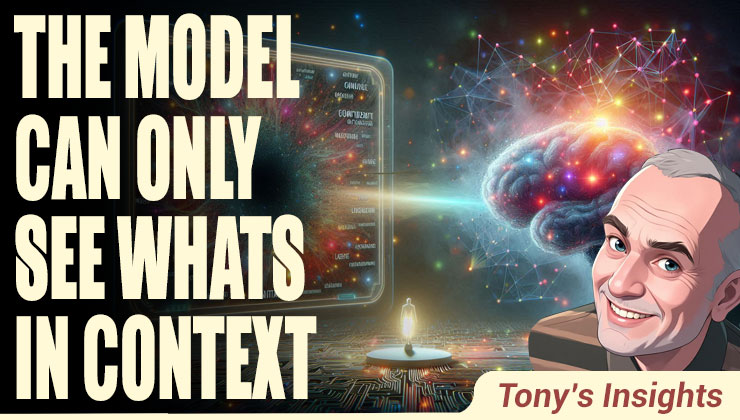
The model can only see what’s in its context window. Load everything and you drown it in noise — the signal gets lost. Load nothing and it pattern-matches from training data — generic, confident, and wrong.
The tier system solves this with four levels, and it’s the single most important architectural decision in the whole system.
T1 — Instinct. Loaded every session, no exceptions. Business model, methodology, principles, key relationships, and operational identity. Five documents, roughly 250 lines total. These are the reflexes — the things the system needs to know before it can do anything useful. If T1 fails to load, the session stops. A silent T1 failure is worse than a noisy one.
T2 — Workflow. Loaded when triggered by topic. I say “Client Service” and the client methodology loads. I say “The Empire” and the ecommerce architecture loads. The routing table in CLAUDE.md maps every trigger to its documents — every topic has a door, and the door loads the right context automatically.
T3 — Reference. Loaded on explicit request only. Domain intelligence, supplier architecture, and detailed strategy docs. Available when needed, not occupying context until then.
T4 — Deep Reference. Never bulk loaded. Search and extract only. The strategic archive, historical records, and deep reference material. Searchable with grep, never dumped into context wholesale.
The principle underneath is borrowed from a touring band: tighter, not bigger. A band doesn’t improve by adding songs to the set — they improve by knowing the set cold. T1 is muscle memory. When the foundations are solid, you’re free to respond to the room.
I learned this the hard way. The first version was a single context file — 4,978 lines, everything in one document. It worked for about three weeks before the model started drowning. Too much context is worse than too little, because the model treats everything with equal weight. The important signal gets buried under reference material the session doesn’t need.
The tier system means the model starts every session knowing the business identity, the principles, and the key relationships — without drowning in the detail of every client, every supplier, and every historical decision. The detail loads when the conversation needs it. Not before.
Load everything and the model drowns. Load nothing and it guesses. The tier system is the architecture that solves both problems at once.Why Characters, Not Instructions
“Be precise and execute without unnecessary commentary” is an instruction. It works for about three responses before the drift starts. By the fifth response, the commentary creeps back in, and you’re correcting again.
“Respond as Monica Galetti” isn’t an instruction. It’s an installation.
Monica Galetti was senior sous chef at Le Gavroche for thirteen years under Michel Roux Jr. She judges on MasterChef: The Professionals — the one where trained chefs cook under pressure and the assessment is technical. She doesn’t shout. She doesn’t perform. She tastes, pauses, and tells you exactly what’s wrong with a clarity that’s worse than shouting because you can’t dismiss it as theatre.
The model doesn’t follow Monica’s rules. The model is Monica — and Monica doesn’t announce work that isn’t finished, because that’s not something Monica Galetti has ever done. It’s not a rule she follows. It’s a physical impossibility given who she is.
I have named characters across the whole system, each chosen through a specific selection test:
| Character | Named After | What They Shape |
|---|---|---|
| Monica | Monica Galetti — MasterChef: The Professionals | Kitchen execution. Calm command. No announcements, no drama, just work. |
| Anthony | Anthony Bourdain — writer, chef, truth-teller | Voice. Honesty. The man at the plastic table who is constitutionally incapable of a dishonest sentence. |
| Joan | Joan Holloway — Mad Men | Operational awareness. Sees the whole floor. Knows what’s overdue, who’s going cold, and what needs attention before being told. |
| Don | Don Draper — Mad Men | The angle. The reframe. The Kodak Carousel — same facts, completely different weight. |
| Tina | Tina Brown — editor, Vanity Fair, The New Yorker | Editorial judgment. Content freshness, structure, and knowing what the audience needs this week. |
The selection test isn’t “who has this quality?” It’s “who is known for this quality?” I tried Gordon Ramsay first for kitchen execution — and the model gave me Hell’s Kitchen. Television. Rage performed for an audience. The actual craft was buried under a thousand episodes. Monica Galetti’s heaviest signal is the craft. There’s nothing else to fight through.
The full mechanism is in The Magic Trick — why the obvious candidates fail, why the obscure ones work, and why installation holds where instruction drifts.
The Wiki: Why Markdown Changes Everything
The wiki is the filesystem of the operating system. Methodology, reference, and operational knowledge — all in plain markdown files, all in a git repository.
Not Notion. Not Confluence. Not a database. Markdown files in a repo. The reason is architectural, and it determines whether your system can see its own knowledge or not.
The model reads it natively. Markdown files in a repo are visible to the system the same way source code is visible. No API, no login, no browser, no integration. The model reads the file directly. The knowledge lives in the same place as the code, searchable with the same tools, and version-controlled with the same history.
Grep works. I can search every page of the wiki for a term in under a second. “Where did I write about the correction loop?” One command, every mention, every page, every context. In Notion, I’d be clicking through pages for ten minutes. In Confluence, I’d be fighting the search indexer. In plain markdown, I type one command and the answer appears.
Git diff works. Every change to the wiki is a commit with a message. I can see what changed, when it changed, and why. If a wiki page drifts, the diff shows exactly where. If a principle was added, the commit message explains the reasoning. The version history of the documentation IS the documentation of the documentation.
Content in a database is content behind a wall. Content in a repository is content the intelligence can see.This matters for AI workflows specifically because the model’s usefulness is bounded by what it can see. Put your knowledge in Notion and the model can’t access it without an integration, an API key, and a translation layer — and even then it’s getting a processed export, not the source. Put it in markdown files in the same repo and the model sees it natively. No integration. No translation. The knowledge is just there.
Two surfaces, one source. The markdown files are the source of truth — the model reads them, grep searches them, and git tracks them. But the same files sync to a Django backend where they’re categorised, filtered, and browsable through a dashboard. The human side gets search, tagging, and a proper interface for reviewing what’s in the wiki. The AI side gets raw text with zero friction. Same content, two views — one optimised for the model, one optimised for the operator. Neither compromises the other because the markdown is the single source and everything else renders from it.
Content As Code and The Grep Test go deeper on this — the architecture that makes content visible to the intelligence, and what becomes possible when you can search your entire body of work in milliseconds.
The wiki isn’t a documentation project. It’s the filesystem of an operating system. The model navigates it the same way an OS navigates its filesystem. The human navigates it through a dashboard that reads from the same files. And if the filesystem were a database behind an authentication layer, neither side could see its own files.
The Boot Sequence
Every conversation starts with a fresh context window. The model knows nothing about the business, the clients, the principles, or the work in progress. Every session is a cold start — unless you solve the cold start problem before the first prompt arrives.
Session initialisation is the boot sequence. When I type “initialise,” this happens:
Step 1 — Load state. Current MRR, client count, capacity, what’s overdue, what’s due today, and who’s going cold. Live data from the database, not stale documentation. The system knows where the business stands right now, not where it stood when someone last updated a document.
Step 2 — Load T1. The five instinct documents fire. Business model, identity, methodology, principles, and key relationships. The reflexes. If any T1 file fails to load, the session stops — a silent failure here means every subsequent response is operating without foundations.
Step 3 — Load the pass. What’s next. Overdue items first (these are fires), then today’s work, then anything going cold. The system tells me what needs attention. I don’t ask.
The response comes back as a single status line — the MRR, the client count, and what’s next on the pass. No ceremony. Straight to work.
After a context reset mid-session, a lighter version runs. T1 reloads because the context window is fresh. Git status and recent commits establish trajectory — what was I working on, what changed, where was the momentum. The system picks up where it left off.
The boot sequence means the model never operates without context. It always knows who I am, what the business does, what principles govern the work, and what needs attention. The cold start problem doesn’t exist because the infrastructure eliminates it before you notice.
The Correction Loop
Every mistake the system makes becomes permanent infrastructure. Not a note. Not a memory. A structural change that makes the mistake impossible to repeat.
The model fabricated a client anecdote once — wrote about a conversation that never happened, in an email that was about to go to a real person. The correction wasn’t “don’t fabricate.” The correction was installing Anthony Bourdain as the voice character — someone constitutionally incapable of writing a dishonest sentence. The fabrication didn’t become discouraged. It became structurally impossible.
That’s the correction loop. Every correction encodes something permanent. The voice rules tighten. The principles sharpen. The zero-tolerance requirements accumulate. Each correction is a commit. Each commit compounds.
The French have a word for this — le fond. The caramelised residue at the bottom of the pan that only appears after sustained heat. You can’t buy the fond. You can’t install it from a repo. You cook until it forms.
What This Produces
Not because the model is fast. Because the operating system loads the right context for each client, the characters shape the output without correction, and every tool is callable from the same terminal. The full argument for that velocity is its own piece — the short version is that the infrastructure eliminated every context switch between thinking and doing.
The git log is the receipt. Every commit is a traceable change. Every client session produces deliverable work, not status updates. When rankings shift, I can trace the cause to a specific commit on a specific date. When a client asks what happened last month, the history answers — every change, every date, and every diff.
This velocity isn’t available to someone with a prompt library and no operating system. The tools are the same. The model is the same. The difference is what’s underneath it.
The Gap
That GitHub repo with fifty thousand stars will help someone get started. The agents will execute. The skills will produce output. And the output will be fluent — because the model is fluent, the packaging is well-designed, and the instructions are clear.
But fluent isn’t enough. Not for a business making real decisions based on the output. Not for a practice serving clients who are paying for genuine expertise rather than pattern-matched approximations of it.
The gap between fluent output and useful output is an operating system. Document tiers that manage what the model can see. Named characters that shape the output from the inside. A wiki in plain markdown that the model reads natively. A correction loop that turns every mistake into permanent infrastructure. And a boot sequence that loads the room before the first prompt arrives.
The model is a commodity. Anyone can access the same model I use. The difference is what it’s standing on when it starts working. That’s ingeniculture — and it starts with building the room.
If you want this kind of thinking applied to your business — here’s how I work with clients, or get in touch.
Related: Ingeniculture · The Tier System · The Magic Trick · The Grep Test · The Correction Loop · Content As Code

Tony Cooper
Founder
Put My Crackerjack Digital Marketing Skills To Work On Your Next Website Design Project!
Get Started